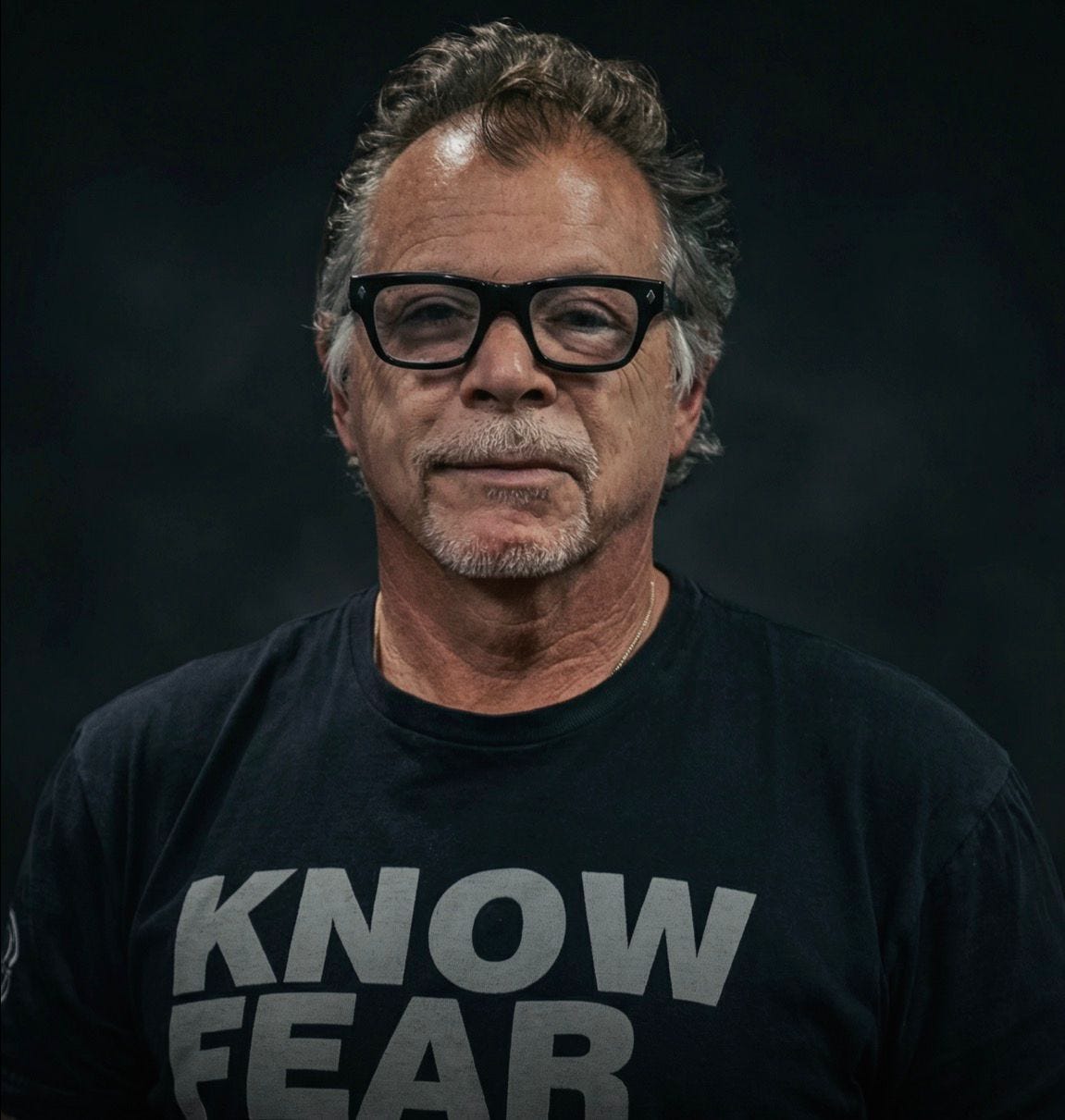
EDITOR’S NOTE:
If you’re considering spending your hard-earned money on a certification—any certification—invest 10 minutes reading this first. Most people won’t. They’ll skim, make assumptions, and keep chasing diplomas. If you’re not most people, keep reading.
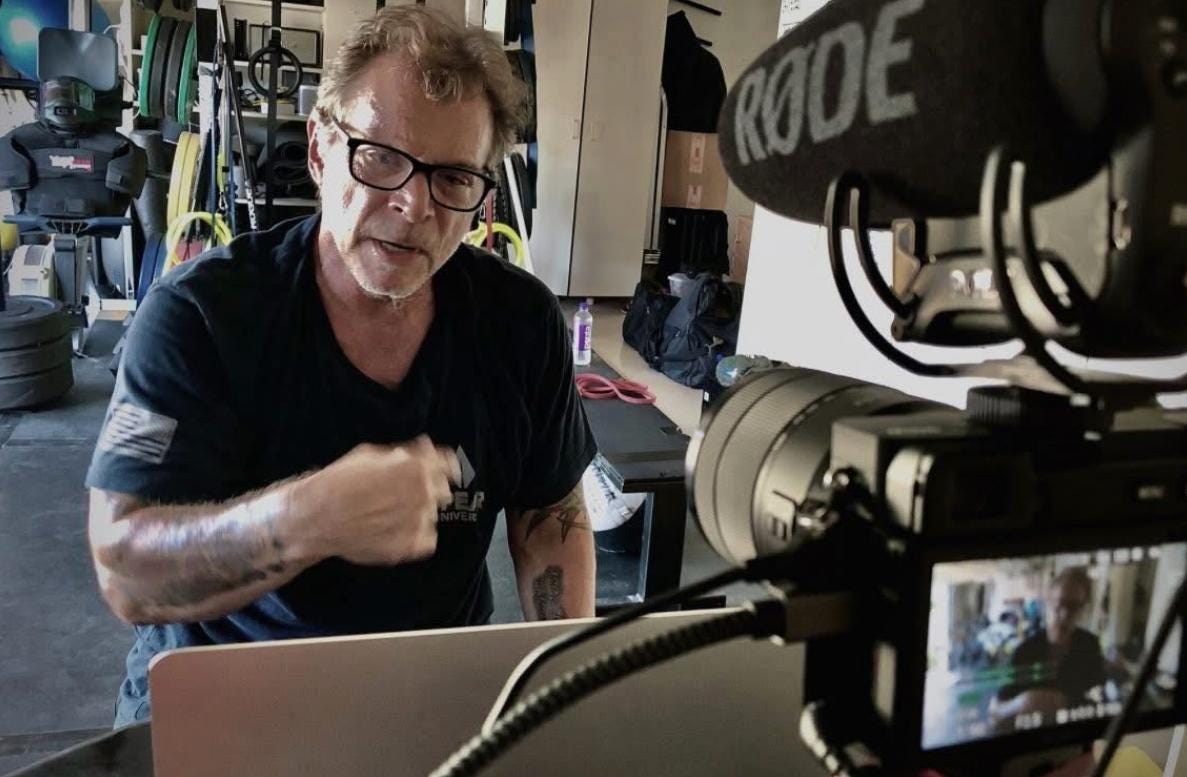
Most weekend certifications are nonsense. Most online courses lack real standards.
But “most” isn’t “all.”
Five years ago, when we launched our online instructor certification, I was asked the same question repeatedly by colleagues, peers, and experts:
“Can you really certify instructors online?”
My answer was the same then as it is now: If you’re coachable and the instructor is legit, you can learn almost anything online.
But I’ll be honest—my instincts and intuition initially said we shouldn’t do this online. I hesitated.
So I brought together my Mobile Training Team—the gang who run my international training. After some animated conversation, I tasked two of them, both with extensive experience and high-level trainer backgrounds in their respective organizations, to build it out. We spent almost six months refining the program before we launched it.
If you think quality training can’t happen online, look at the platform MasterClass—billions in valuation teaching cooking, writing, strategy through premium digital courses. Look at Gracie University. Look at the thousands of people who’ve used our online and digital programs to learn real self-defense despite being restricted by geography or time.
The medium isn’t the problem. The methodology is.
Here’s where most programs in the industry fail. They’re assembly lines. You sign up, your diploma’s waiting. There are no standards. They’re for people who are chasing diplomas and companies just looking to make money.
In our program, we’re not just teaching you our system. We’re also testing whether you can teach it to others. And just because you signed up doesn’t mean we printed your diploma. You still need to pass the course.
Truth is, we built something different. To understand why it works, let me tell you three stories...
Story 1: The Navy SEAL Dilemma (1993)
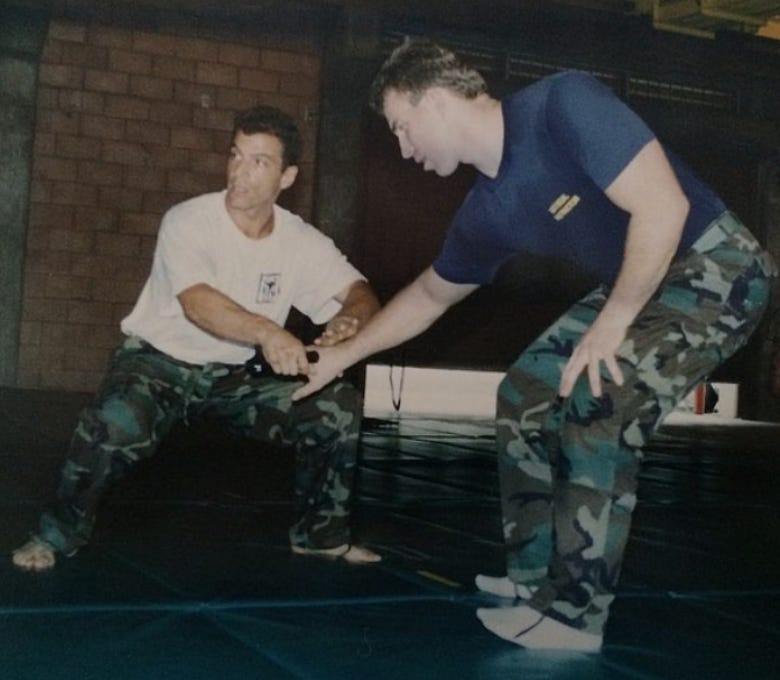
In the early 90s, I was hired to train the Advanced Combat Training Group for Naval Special Warfare on the SPEAR System® and my Ballistic Micro-Fight approach.
In the middle of the first course, they were already talking about rebooking me. We were developing quite a rapport, and it was during our second engagement that they shared a problem they were facing with their 30-day Combatives program.
Think about that: a 30-day intensive program, taught by Navy SEAL instructors, exclusively for Navy SEALs. On paper, it should have been the gold standard. But something wasn’t working.
Graduates would return to their platoons with a certificate that said “Combatives Instructor.” But think about the type of person who becomes a Navy SEAL. These are alpha males. They like to fight. Inside every platoon, you had guys with extensive street fighting experience, boxing, wrestling, or just raw toughness.
They’d challenge the new “instructor” right away: “So you’re our new combatives expert? Last month you couldn’t beat us up, but now you can? Let’s see what you learned.”
Invariably, most of the time, these guys got their asses kicked. Because you can’t necessarily teach somebody how to fight in 30 days.
I told them they had two problems:
First, the guy leaving after 30 days needs to understand his role. He may be safer. He may be better. But he’s only been doing this for 30 days. He’s not there to be the toughest guy in the platoon. He’s there to bring back training modalities, concepts, and protocols—to run training sessions that enhance survivability, improve force readiness, and increase lethality across the entire unit.
Think of it like a 30-day “How to Play Piano” course. You don’t graduate as a virtuoso ready for Carnegie Hall. But maybe you can play a few songs. More importantly, you can teach people scales, tempo, rhythm, and run practice sessions so everyone improves.
Second, this should never have been marketed as a Combatives Instructor course. It should have been called a Combatives Coach or Trainer course. There’s a difference between a coach and a fighter. When you market a course as “making someone a fighter,” you’re setting them up to fail. You cannot fake experience. But when you position it as coaching certification—teaching people how to run training programs, manage safety, and transfer skill—the psychology changes. The goal isn’t to be the toughest guy in the room. The goal is to be the best educator in the room.
Story 2: The Angelo Dundee Principle
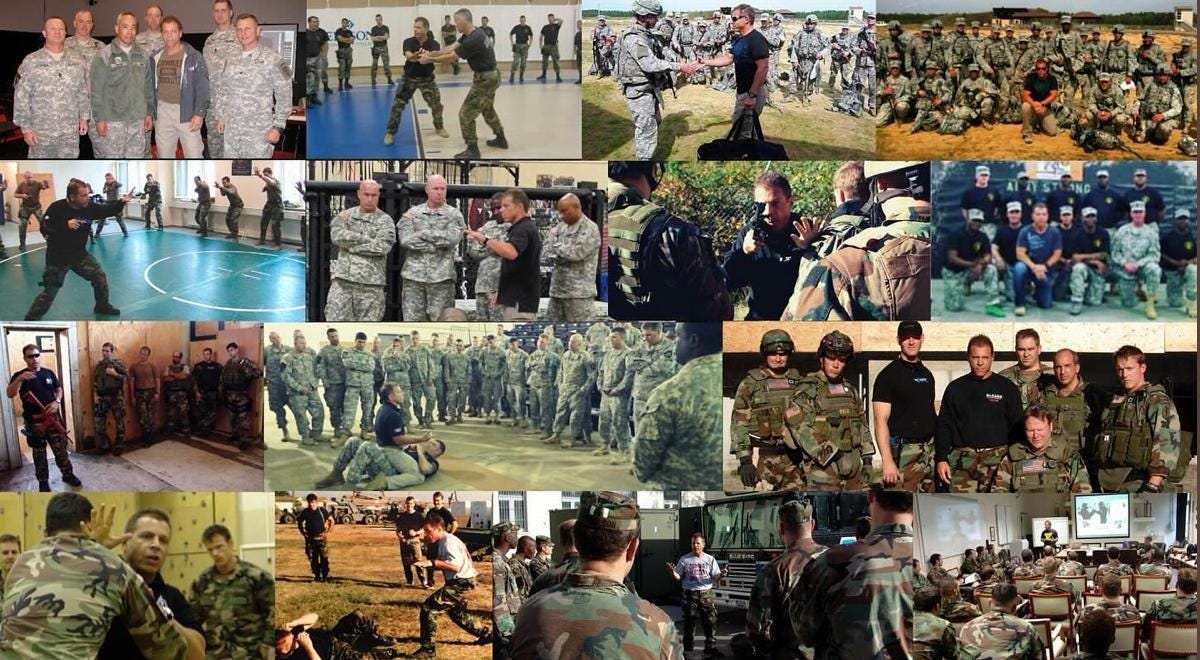
In 1999, I got a call from a unit in the US Army. They wouldn’t say which unit—just “a unit in the US Army”—which told me exactly who they were.
I was talking to a guy named Josh (who I later learned was not only a badass operator, this Squadron’s combatives SME, but he was also a world-ranked kickboxer and pro boxer). He wanted to fly up to Montreal with a couple of guys to “check me out.” I could read the energy on the call immediately: they had discretionary funds, and they wanted to come up and fight me.
I called him on it. I said, “Look man, if you come up here and we spar, and you kick my ass, you’ll just go home saying, ‘We beat him up, no big deal.’ That proves nothing.”
I asked him, “Do you know who Angelo Dundee is?”
He laughed. “Yeah, I do.”
I said, “Do you think Ali or Sugar Ray Leonard thought that Angelo Dundee could beat them up? Or do you think Ali or Sugar Ray Leonard challenged Angelo Dundee and said, ‘If you last with us, we’ll have you coach us?’ How ridiculous is that? These amazing fighters picked Angelo Dundee because of his coaching skills. I repeat, coaching skills.”
They understood that Dundee knew something about strategy, movement, and getting the best out of people.
I told him: “Bro, whether you can beat me or not isn’t the question because I’m not your f*cking bodyguard. If you are serious about enhancing the survivability of your unit, then you want to know if I can TEACH.”
That stopped him in his tracks.
I flew down on my own dime. I actually said to them, “I’ll fly down on my own dime. If you don’t like it, don’t pay me.” They accepted. After day one, they took me out to dinner and asked me if I could extend my trip. After day two, they said, “We’d like to pay you for the trip” and “When can we get you back here?” That began a long relationship with this particular unit.
Story 3: The Aikido Master & The “Weekend” Myth
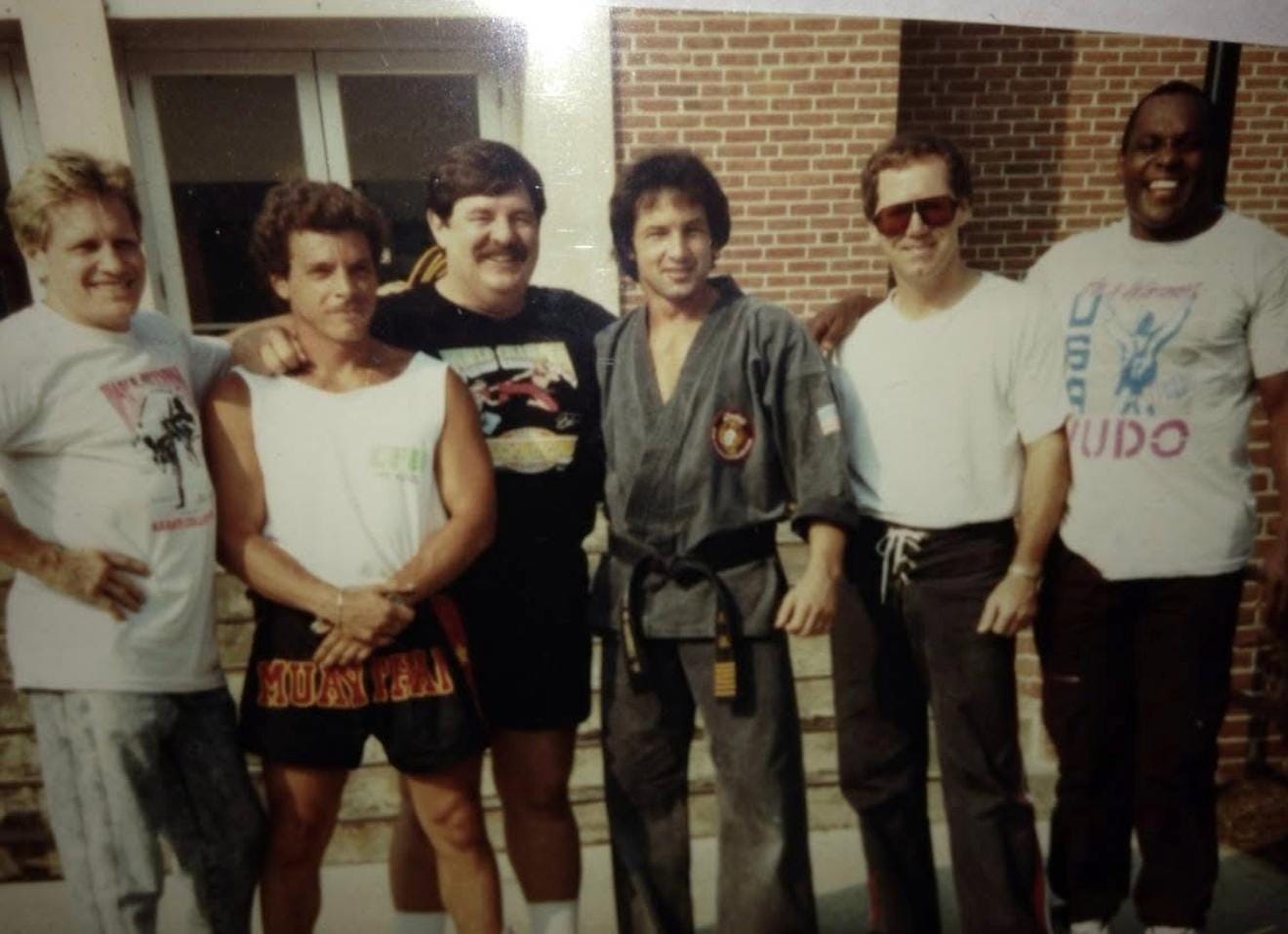
In the mid-2000s, I was a guest instructor at Master Danny Lane’s Martial Arts Summer Camp.
Back then, there was a circuit on the East Coast where some of the top names in martial arts—like Joe Lewis, Michael De Pasquale, Jerry Beasley, and others—all had these camps. I was invited to teach on this circuit.
After our seminars, we had a booth area set up where students could come talk to us. My table was packed. Mostly parents saying things like, “Your stuff is the missing link. You talk about situational awareness. You talk about fear. You talk about de-escalation.”
Remember, this was 25 years ago. This wasn’t in the middle of COVID, where everyone and their mother jumped on the “de-escalation” bandwagon.
There was a very well-known Aikido master whose table was beside me. He overheard me talking to three women about my two-day seminar, and he interrupts. He says, “Tony, I’ve been studying martial arts for 30 years, and I gotta say, as good as you are, you just can’t learn self-defense in a weekend.”
I looked at him and said, “Bro, just because YOU can’t do it doesn’t mean I can’t do it. So please don’t project your limitations on me.”
You should have seen his face.
I asked him, “Do you know with 100% certainty that you could defend yourself?”
He answered defensively and quickly: “Yeah, but it’s taken me 30 years of training.”
I said, “Well, some people don’t have 30 years to train.”
They might get attacked tonight. They might get attacked next week. They might get attacked as a white belt. When you say “it takes 30 years,” you are telling people, “I hope you don’t get attacked for the next three decades because you won’t be ready.”
Like many martial arts and self-defense experts, this individual was confusing martial arts with self-defense. They are completely different.
The Timeline: 45 Years of Teaching
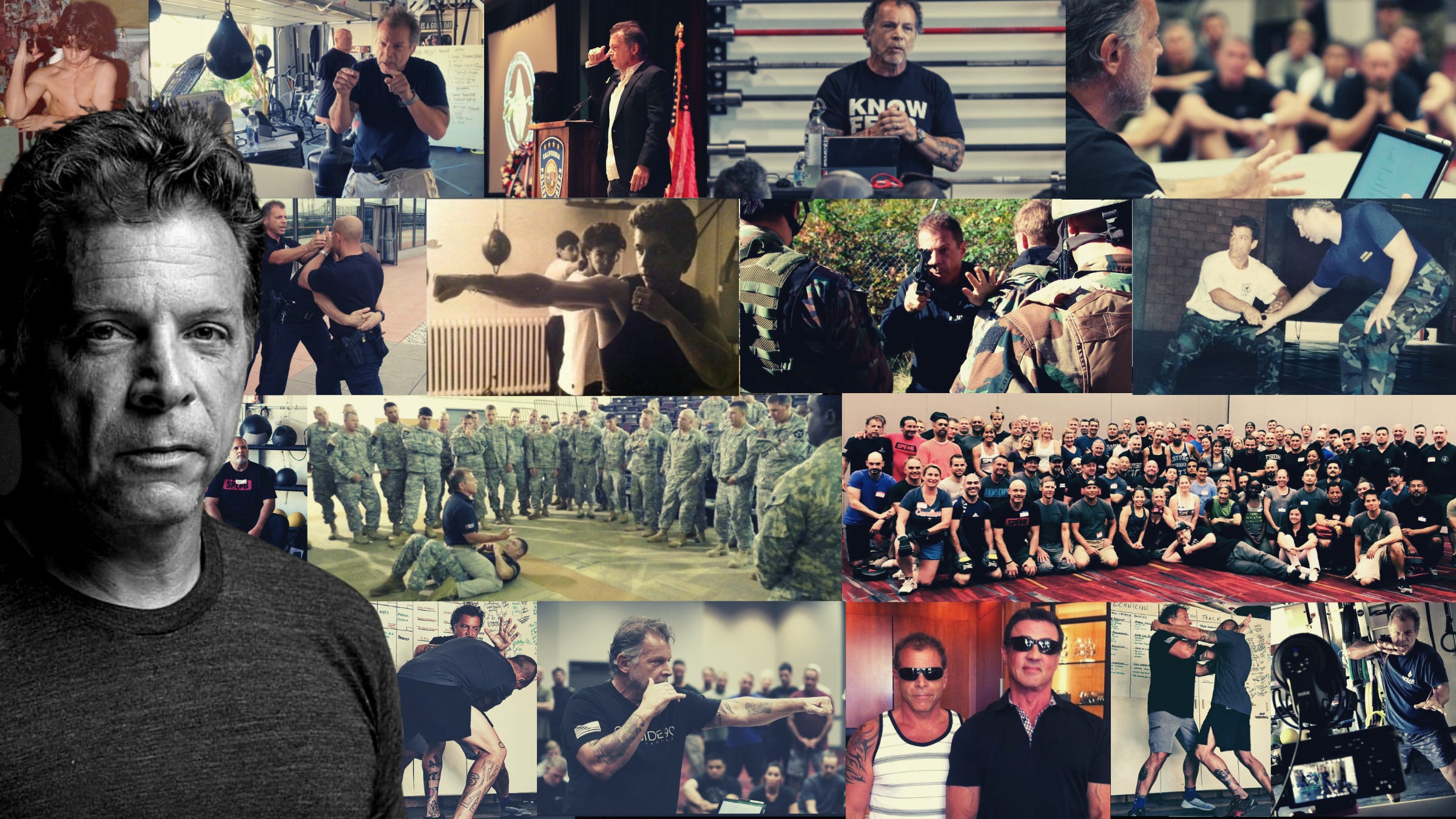
The stories above span three decades. I actually started teaching in 1980—do the math. That’s longer than some of the people questioning our methods have been alive.
If you’re questioning something with respect and an open mind because you have a real question, that’s one thing. If you’re questioning it because you’re trying to put down somebody else to build up your brand—because you’re tired of people asking you about a competitor—that’s a different story altogether.
Here’s more context: I didn’t start teaching online because of COVID. That’s when I started my online certification. I’d been teaching online for a couple of decades before COVID, before Zoom was even a company. I used a program called Cisco WebEx.
My system was world-renowned for decades, and organizations would hire me for online consultation because we couldn’t get in the same room together.
The reason my material could be taught online is because I wasn’t teaching technique. I was teaching people how to think, how to manage fear, how to manage violence. I was teaching about scenario design. I started scenario-based training in 1980. We created a program called KNOW FEAR®, which included the Cycle of Behavior®—a decision-making formula for how to manage fear in high-stress situations. It was a next-level OODA loop.
In other words, I wasn’t teaching people how to kick or punch. This was a complete system, a methodology.
Institutional Validation
I’ve seen this for decades: A cop walks into a class, signs up, and the instructor finds out they’re a police officer. Then the instructor embellishes their resume by saying, “We’ve taught cops.” A police officer or a firefighter or somebody in the military who signed up for your group class is not the same thing as being asked to come in and professionally teach a defensive tactics unit or a police agency.
This is 100% a big problem where people throw around credentials. Even if you go back to the “Coach vs. Fighter” discussion—someone says, “I was a cop,” but it doesn’t mean they know how to teach personal safety. Not trying to throw anyone under the bus here, but have you looked at most police altercations when there’s sudden violence? Most of them have no clue how to manage extreme close-quarter violence.
Just because someone was a police officer or in the military doesn’t automatically make them a great instructor. You see this if you go to the firearms community (I’m friends with some of the best firearms instructors in the world)—this is a big controversy for them too. Someone gets out of the military and says, “I was part of this unit, so I’ll teach you how to shoot.” We don’t know if they’re a good shot. We don’t know if they’ve been in a gunfight. We don’t know if their communication skills are world-class. People are leveraging their resume to solicit students.
Here’s a good example: Back in Montreal, where I used to live in the 80s, I had a cop sign up. And he trained with me for years, but he was one police officer. My marketing didn’t change to “We teach police officers.” If somebody asked me, I’d say, “Yeah, we have cops in our class.” But it wasn’t until 1993, when Gary Klugiewicz, the chairman of the American Society of Law Enforcement Trainers, asked me to come present in Dallas to hundreds of international trainers, that I could say I’ve trained cops.
Incidentally, that invitation exploded our business. And it was then, in 1993, that I made the toughest choice I ever made and the best choice I ever made. I closed my school that I had run for over 13 years and went on the road teaching cops full time.
Word of my system spread internationally very quickly, and our system was growing all over. We are in policy in police departments. We are in hundreds of police agencies and military organizations worldwide. We’ve actively impacted over 500,000 people, and I’ve had thousands of instructors go through our certifications, which started in 2001.
The Numbers Don’t Lie
When attention and momentum like this begin to snowball, there’s scrutiny. Organizations started requesting medical references, scientific validation, peer review. We welcomed it.
We had one group in the UK have England’s top forensic specialist attend my course to audit it, and he produced a 97-page document on the system that is available to anyone with a government ID. Obviously, he gave it a massive thumbs up.
Here’s another example of the impact we’ve had: We are the only defensive tactics system in the world listed by brand in the ACPO (Association of Chief Police Officers) manual for the entire United Kingdom. This wasn’t a quick deal; the process took over seven years. Every police officer and public safety professional in the UK was exposed to the foundational elements of the SPEAR System® startle-flinch conversion methodology.
Another organization in the UK, the Dorset Police Agency, conducted a 5-year independent study that resulted in a 43% reduction in head trauma and a 25% reduction in use of force complaints. These are incredible numbers, and I share them with you to understand that there is some serious research and foundation behind the work that me and my team provide.
This White Paper-level research into the efficacy of the SPEAR System® led to an evaluation by the NTRG (National Tactical Response Group), who then adopted the SPEAR System® as their baseline for the prison service and have been teaching it ever since.
So Here We Are, Full Circle
Can you get certified online?
I said it right in the opening paragraph: It depends. Are you coachable? Is the program legit? Are the trainers legit?
So the truth of the matter is, whether you’re looking at my program or some other self-defense program—or canoeing, or cooking, or shooting—do your research. Question the legitimacy of these courses. Research the instructor. Are the testimonials generic? Are they using real names? What are your Spidey senses telling you?
The Attributes of the Exceptional
Something I’ve noticed over the decades of professional training is that there are certain people who really stood out. Remember, these are all martial artists, self-defense experts, concealed carry holders, defensive tactics instructors, combatives instructors.
What stood out with them were the attributes of curiosity, an open mind, a willingness to learn, and probably the single most important factor: They realized that this training wasn’t about them per se. It was about their role as leaders and educators.
Think back to the Navy SEAL story. Those instructors had a singular mission: to enhance the survivability of the people they were tasked to train. It wasn’t a tough man contest.
Having said that, even when working with professional groups, you still had people standing there with their arms crossed, wondering if they could beat me up. Their body language was like the original Roadhouse, people looking at Patrick Swayze thinking, “I thought he’d be bigger.”
Who Attends Our Programs?
Professionals. Conscientious instructors.
People who recognize, after doing their research, that their program is missing elements of scenario training, or the connection between biology, kinesiology, and psychology, startle-flinch conversion, fear management, and de-escalation. And so on.
These are all principles and concepts we pioneered in the 80s and refined over decades. When a professional has their blind spots exposed, they lean into the training. Progress is the objective. They want to make sure that they are providing the best training for their students, and they welcome the continuing education.
For the record, we don’t just let anyone in. There’s an application process. We don’t just print diplomas; there’s pre-course work, videos to study, manuals to read, written exams, live real-time evaluation of movement comprehension, teaching ability, and more. We actually fail people. We don’t hand out participation trophies.
Thanks for sharing this trip down memory lane. After four decades in this field, I felt an obligation and responsibility to set the record straight and share my thoughts and experiences.
Have you ever read the book On Killing by Lieutenant Colonel Dave Grossman? Dave and I have known each other for 30 years. He sent me this a while back:
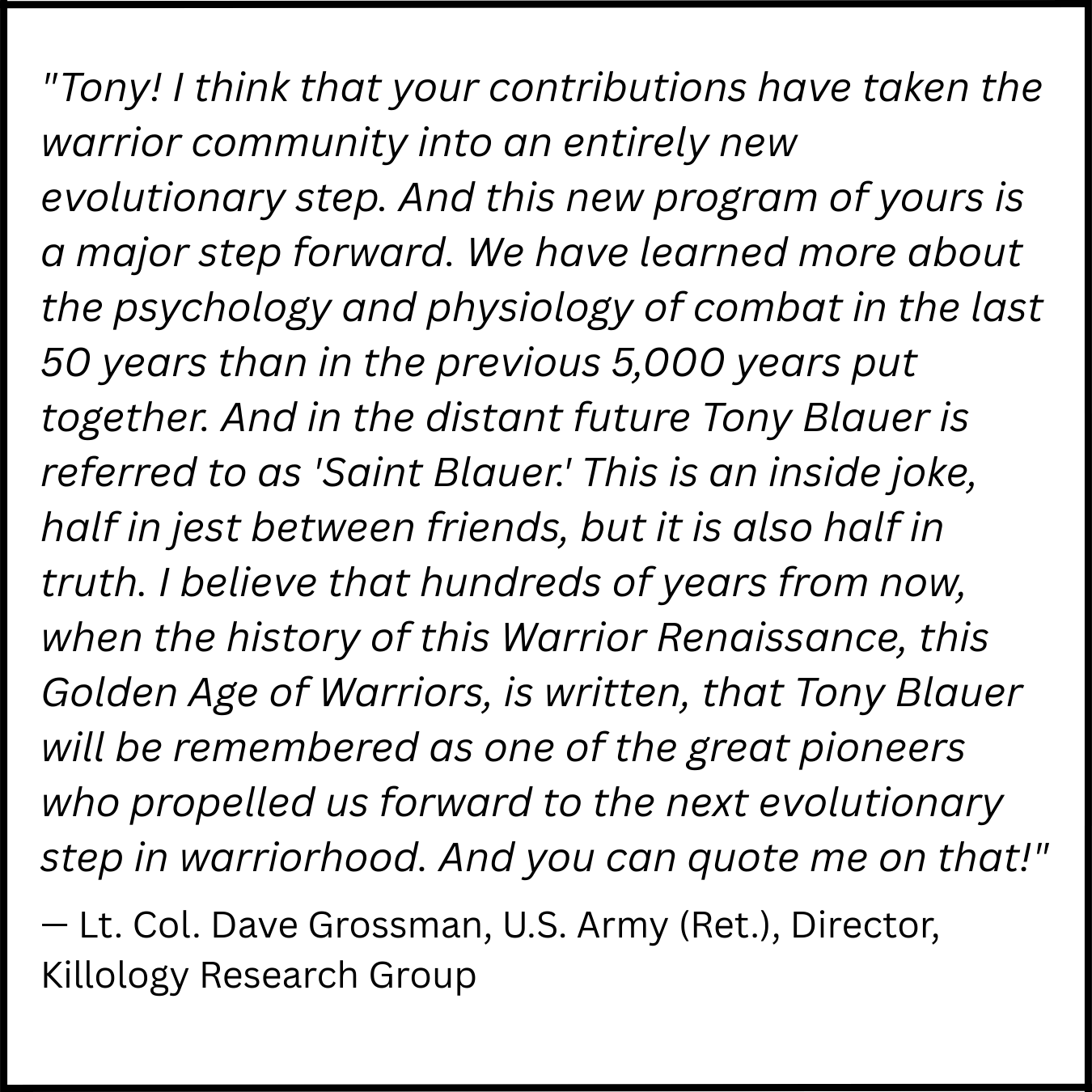
Thank you, Brother Dave. You flatter and honor me.
Well, there you have it.
If you have questions about my system and my program, hit us up—me and my team are always happy to engage.
If you have questions about other programs? I don’t comment on programs I haven’t personally taken. If I thought their program was better than mine, I’d be teaching that one. 😉
Remember: Don’t confuse the medium with the method. Don’t confuse the trademark with the truth. And don’t confuse a fighter with a coach.
Stay safe out there.
Coach Blauer
P.S. IF OUR SYSTEM IS GOOD ENOUGH FOR OUR POLICE AND WARFIGHTERS, IT’S PROBABLY GOOD ENOUGH FOR YOU.
“One man taught me more about the lead up to the fight and most importantly the first few seconds of the fight than all the others combined. That instructor is Tony Blauer... If I had to send a member of my family to learn personal protective skills, there would be no hesitation, it would be to Tony Blauer.”
— Ron Donvito, USMC (Ret.), Founder L.I.N.E. System
Are You Curious and Coachable?
Pat is, and that’s why he’s grown into one of the most successful instructors in the world.
Do you know Pat McNamara?
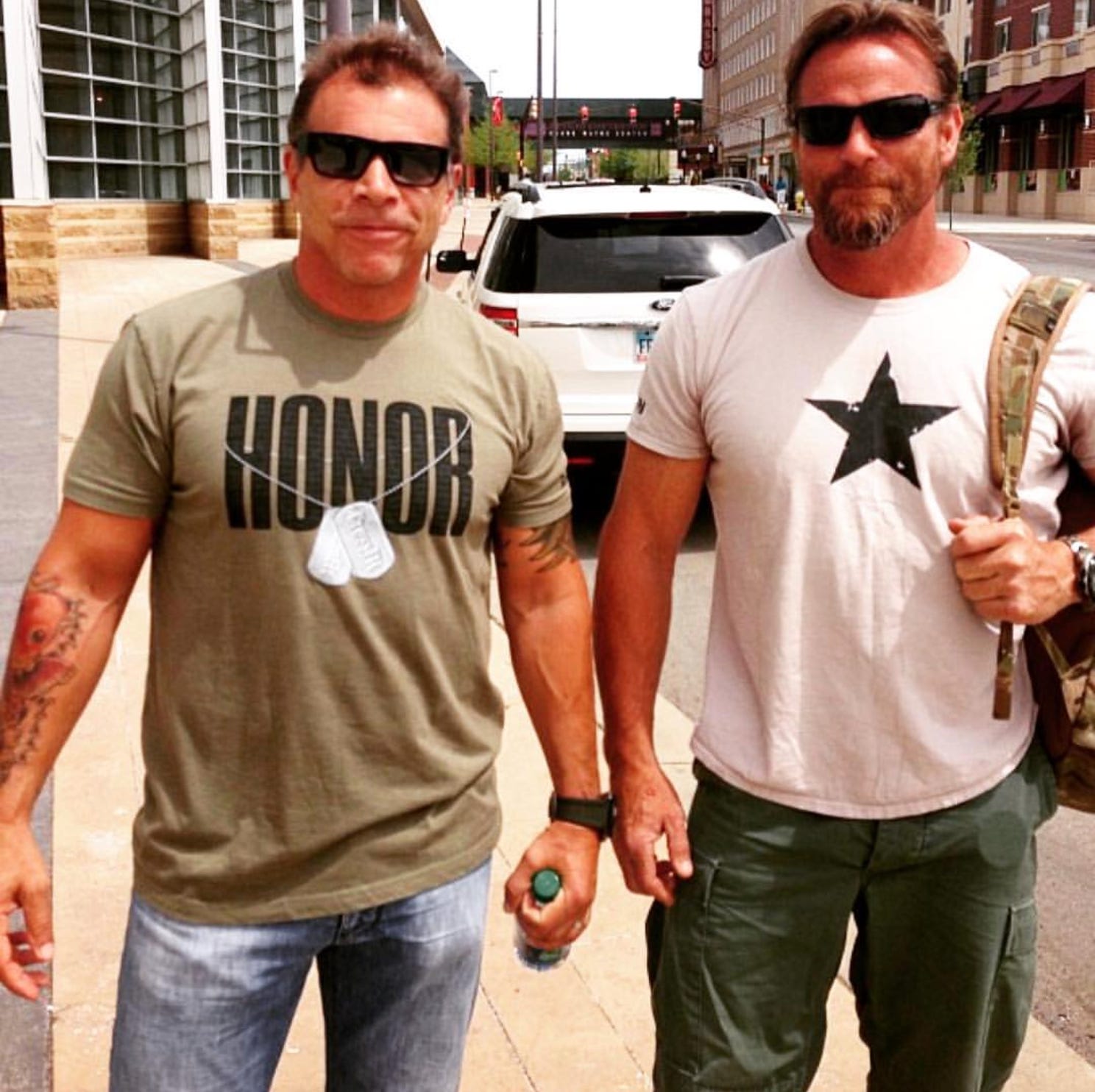
I first met Sergeant Major Pat McNamara back in 1999 when I began training his unit. He was also in my course on September 11th, 2001—one of America’s darkest days, the 9/11 terrorist attacks. We’ve known each other ever since.
Pat has referenced me in his books, online, and on his podcasts. Many of you reading this will know who he is. He’s one of the top instructors in the world and is very famous for his brand, Basic Dude Stuff.
I was tagged in his podcast where CJ Ortiz, his co-host, asked him after all these years who had the biggest influence on him.
Listen to what Pat had to say.
Want to learn how to teach the world’s most scrutinized and vetted self-defense system?
Apply for our weekend certification here.